Philly EnterpriseTech Highlights 1/16: Walgreens, Microsoft Ink Strategic Deal to “Transform Healthcare Delivery”; Like The Shutdown, TiVo-Comcast Legal Fight Has No End in Sight
Vanguard founder Jack Bogle dead at 89
Fiserv is buying First Data in a $22B deal
Radian makes another data-oriented acquisition
Walgreens, Microsoft Ink Strategic Deal to “Transform Healthcare Delivery”
AWS For Everyone: New clues emerge about Amazon’s secretive low-code/no-code project
TiVo-Comcast Legal Fight Has No End in Sight
DuckDuckGo will use Apple Maps for local searches on the web; furthers my speculation that Apple would be a great partner for DuckDuckGo
Another view on "Is digital health in a bubble?"
Reading @beckershr CHOP sues over 'misappropriation' of its research: 4 things to know https://t.co/BTKN0xnK8N
— Tom Paine (@phillytechnews) January 16, 2019
Fiserv is buying First Data in a $22B fintech megadeal https://t.co/zWvf7sQz3x via @techcrunch
— Tom Paine (@phillytechnews) January 16, 2019
Radian Acquires Five Bridges Advisors | Business Wire https://t.co/5x6f8UnRJj
— Tom Paine (@phillytechnews) January 16, 2019
A better name for We(Work) would be WeWe
— Tom Paine (@phillytechnews) January 16, 2019
We Company CEO in hot water over being both a tenant and a landlord https://t.co/JI0fGkcUuD via @techcrunch
— Tom Paine (@phillytechnews) January 16, 2019
#Infor gets $1.5 billion more in funding ahead of planned IPO: Reuters - PE Hub: https://t.co/XFmJjj0CR6
— Tom Paine (@phillytechnews) January 16, 2019
New:
— Tom Paine (@phillytechnews) January 16, 2019
Fiserv is buying First Data in a $22B fintech megadeal-based roundCorner acquired by https://t.co/ivHgafJcMb https://t.co/9MCM9R5bPO pic.twitter.com/ixkCgqmvrp
Walgreens, Microsoft Ink Strategic Deal to “Transform Healthcare Delivery” https://t.co/G5CvISeApy #health #feedly
— Tom Paine (@phillytechnews) January 15, 2019
AWS For Everyone: New clues emerge about Amazon’s secretive low-code/no-code project https://t.co/P1OKvYXAx5 #prime #feedly
— Tom Paine (@phillytechnews) January 15, 2019
My first tweet - 10 years ago today https://t.co/5DinWyqcXE
— Tom Paine (@phillytechnews) January 15, 2019
Rimini and Oracle's legal eagles return to the ring in front of Supreme Court https://t.co/1cf9xfnjlX via @theregister
— Tom Paine (@phillytechnews) January 15, 2019
TiVo-Comcast Legal Fight Has No End in Sight | Light Reading https://t.co/nsdw4Tcyko via @Light_Reading
— Jeff Baumgartner (@thebauminator) January 15, 2019
DuckDuckGo will use Apple Maps for local searches on the web https://t.co/zm1HMtwsXA pic.twitter.com/SW1D9gpHNZ
— The Verge (@verge) January 15, 2019
New definition of #iPaaS goes far beyond a collection of tools. It's about a unified platform connecting people, processes and technology to help get the outcomes you need. #iPaaS2dot0 has arrived thanks to @boomi - the inventor (and now reinventor) of the integration market! https://t.co/ef9CTSVOC4
— Steve Wood (@stevewoodwho) January 15, 2019
Elemica and crossinx Deliver #Blockchain Pilot for Leading Global #Chemical Manufacturers https://t.co/K8NBoWireu
— Becky Boyd (@BeckyJBoyd) January 15, 2019
Netflix will raise prices for US subscribers, with its most popular plan going up to $13 per month https://t.co/bdUdFsmbWe by @anthonyha
— TechCrunch (@TechCrunch) January 15, 2019
NBCU’s still-not-officially announced streaming service launches in 2020 per @bristei. Aimed at NBC pay tv subs,
— Peter Kafka (@pkafka) January 14, 2019
will have ads. https://t.co/t4jMY0OUec
An RSN Story: There is a Sucker Born Every Minute #nowplaying #consumerswin https://t.co/lPiR52Auty via @RichBTIG
— Tom Paine (@phillytechnews) January 15, 2019
Didn't learn its lesson with previous CEO $USAT
— Tom Paine (@phillytechnews) January 14, 2019
USA Technologies overhauls management after accounting issues uncovered https://t.co/EshSPSrSbS via @PHLBizJournal
Is digital health in a bubble? Depends on who you ask, writes @kevinbtruong https://t.co/PzbThNwLCe #digitalhealth @Rock_Health
— MedCity News (@medcitynews) January 14, 2019
Malvern-based Trice Medical Closes $18.3 Million Series C Extension https://t.co/ngkasWR36N
— Tom Paine (@phillytechnews) January 14, 2019
More Start-Ups Have an Unfamiliar Message for Venture Capitalists: Get Lost https://t.co/9V4zvHZgyU
— Tom Paine (@phillytechnews) January 14, 2019
Vanguard's Bogle dead at 89
Jack Bogle, founder of the Vanguard Group, died at the age of 89, it was announced this evening.
Bogle, a very bright and inventive man, revolutionized investing and financial markets with a very simple concept - index funds. Vanguard was founded in 1974.
He died in Bryn Mawr. The cause was cancer.
"Jack Bogle made an impact on not only the entire investment industry, but more importantly, on the lives of countless individuals saving for their futures or their children's futures," said Vanguard CEO Tim Buckley. "He was a tremendously intelligent, driven, and talented visionary whose ideas completely changed the way we invest. We are honored to continue his legacy of giving every investor 'a fair shake.'"
A look back at the life of Vanguard’s founder
COMPANY NEWS JANUARY 16, 2019
https://investornews.vanguard/a-look-back-at-the-life-of-vanguards-founder/?cmpgn=Ext:SM:RIG:XX:011619:XX:POST:XX:TW:Oth:XX:XX:XX:sf206086288&sf206086288=1
Vanguard regrets to announce the passing of our founder, John Clifton Bogle, who died January 16, 2019, at his home in Bryn Mawr, Pennsylvania. He was 89.
John BogleMr. Bogle had near-legendary status in the American investment community, largely because of two towering achievements:
He introduced the first index mutual fund for individual investors and, in the face of skeptics, stood behind the concept until it gained widespread acceptance.
He drove down costs across the mutual fund industry by ceaselessly campaigning in the interests of investors. Vanguard, the company he founded to embody his philosophy, is now one of the largest investment management firms in the world.
“Jack Bogle made an impact on not only the entire investment industry, but more importantly, on the lives of countless individuals saving for their futures or their children’s futures,” said Vanguard CEO Tim Buckley. “He was a tremendously intelligent, driven, and talented visionary whose ideas completely changed the way we invest. We are honored to continue his legacy of giving every investor ‘a fair shake.’”
“The Vanguard Experiment”
Under Mr. Bogle’s tutelage, Vanguard began operations on May 1, 1975. He called the new venture “The Vanguard Experiment,” where mutual funds would be operated at cost and independently. Vanguard thus represented a radical change from the traditional mutual fund structure, in which an external management company manages a fund for profit.
“Our challenge at the time,” Mr. Bogle recalled a decade later, “was to build … a new and better way of running a mutual fund complex. The Vanguard Experiment was designed to prove that mutual funds could operate independently, and do so in a manner that would directly benefit their shareholders.”
An aficionado of naval history, Mr. Bogle named the company after Admiral Horatio Nelson’s flagship at the Battle of the Nile in 1798; he thought the name “Vanguard” resonated with the themes of leadership and progress. The nautical theme can still be seen in Vanguard’s logo and communications to shareholders.
“Father of indexing”
In 1976, Vanguard introduced the first index mutual fund for individual investors. Ridiculed by others in the industry as “un-American” and “a sure path to mediocrity,” the fund, First Index Investment Trust, collected a mere $11 million during its initial underwriting. Now known as Vanguard 500 Index Fund, it has grown to be one of the industry’s largest, with more than $400 billion in assets. Today, index funds account for more than 70% of Vanguard’s $5.1 trillion in assets under management; they are offered by many other fund companies as well and they make up most exchange-traded funds (ETFs). For his pioneering of the index concept for individual investors, Mr. Bogle is often called the “father of indexing.”
Standing up for the individual investor
Mr. Bogle and Vanguard again broke from industry tradition in 1977, when Vanguard ceased to market its funds through brokers and instead offered them directly to investors. The company eliminated sales charges and became a pure no-load mutual fund complex—a move that would save shareholders hundreds of millions of dollars in sales commissions.
A champion of the individual investor, Mr. Bogle is widely credited with helping to bring increased disclosure about mutual fund costs and performance to the public. His commitment to safeguarding investors’ interests often prompted him to speak out against practices that were common among his peers in other mutual fund organizations.
“We are more than a mere industry,” he insisted in a 1987 speech before the National Investment Company Services Association. “We must hold ourselves to higher standards, standards of trust and fiduciary duty. Change we must—in our communications, our pricing structure, our product, and our promotional techniques.”
Early career
The New Jersey native began his career in 1951 after graduating magna cum laude in economics from Princeton University. His senior thesis on mutual funds had caught the eye of fellow Princeton alumnus Walter L. Morgan, who had founded Wellington Fund, the nation’s oldest balanced fund, in 1929, and was one of the deans of the mutual fund industry. Mr. Morgan hired the ambitious 22-year-old for his Philadelphia-based investment management firm, Wellington Management Company.
Mr. Bogle worked his way up through the ranks, and, in 1967, he was named president. Mr. Bogle became the driving force behind Wellington’s growth into a mutual fund family after he persuaded Mr. Morgan to start an equity fund that would complement Wellington™ Fund. Windsor™ Fund debuted in 1958.
In 1967, Wellington Management Company merged with the Boston investment firm Thorndike, Doran, Paine & Lewis (TDPL). Seven years later, a management dispute with the principals of TDPL led Mr. Bogle to form Vanguard in September 1974 to handle the administrative functions of Wellington’s funds, while TDPL/Wellington Management would retain the investment management and distribution duties.
Beyond Vanguard
Health problems caused Mr. Bogle to step down as Vanguard’s chief executive officer in 1996. The same year, he underwent a heart transplant. A self-described “battler by nature,” Mr. Bogle came through the surgery with flying colors. He returned to work as senior chairman until 1999, when he turned 70, the maximum age for a Vanguard board member. Mr. Bogle never actually retired; he became president of the Bogle Financial Markets Research Center to continue his work on behalf of investors. He also continued to write and speak about the industry.
Awards and accomplishments
In 2004, Time magazine named Mr. Bogle one of “the world’s 100 most powerful and influential people” and Institutional Investor magazine presented him with its Lifetime Achievement Award. In 2010, Forbes magazine described him as the person who “has done more good for investors than any other financier of the past century.” Fortune magazine designated him one of the investment industry’s four “Giants of the 20th Century” in 1999. In January 2012, some of the nation’s most respected financial leaders celebrated his career at the John C. Bogle Legacy Forum.
Mr. Bogle served on several investment industry boards: chairman of the board of governors of the Investment Company Institute (1969–1970) and chairman of the NASD’s (now FINRA) Investment Companies Committee (1972–1974). In 1997, he was appointed by then-SEC Chairman Arthur Levitt to serve on the Independence Standards Board.
Mr. Bogle was sought after in the corporate community and served as a director for several corporations. He received honorary doctorate degrees from 14 universities, including his alma mater, Princeton.
Civic work
An avid booster of Philadelphia and the surrounding area, Mr. Bogle was active in civic affairs. “I loved Philadelphia, my adopted city that had been so good to me. I established my roots there, finding even more unimaginable diamonds,” he wrote in one of his many books.
His civic work extended to organizations involved in education, leadership, and public affairs. He served as the first chairman of the board of trustees and chairman emeritus for the National Constitution Center. Former President Bill Clinton was also on the board and later wrote the foreword to the paperback edition of Mr. Bogle’s book Enough. True Measures of Money, Business, and Life.
Sportsman and family man
Mr. Bogle was born May 8, 1929, in Montclair, New Jersey. He worked his way through Blair Academy and Princeton University as a waiter and also managed Princeton’s athletic ticket office.
A tall, athletic man who sported a crew cut for most of his life, Mr. Bogle played squash, tennis, and golf, and also enjoyed sailing. He was often described as a “fierce competitor” on the court and course, a demeanor he also maintained on the job. Reading was among his pleasures, as was The New York Times crossword puzzle, which he often completed in less than 20 minutes.
He married Eve Sherrerd in 1956. The couple had 6 children—daughters Barbara Bogle Renninger, Jean Bogle, Nancy Bogle St. John, and Sandra Bogle Marucci, and sons John C. Bogle Jr. and Andrew Armstrong Bogle. They had 12 grandchildren and 6 great-grandchildren.
John Bogle, the founder of Vanguard Group and "father of index investing," who started his own index fund to help Main Street investors, died at 89. https://t.co/lOiLP9nog5 pic.twitter.com/ykNJ3TrDYU
— USA TODAY Video (@usatodayvideo) January 17, 2019
How the hard-charging, hypercompetitive founder of Vanguard became a successful do-gooder https://t.co/sa2qYArE42 via @bopinion
— Tom Paine (@phillytechnews) January 17, 2019
Philly EnterpriseTech People News 1/15
Follow @Phillytech People News

Subscribe to Philly Tech People News by Email
David Sorin gives remarks at NJ Tech Council Awards Ceremony (NJTechWeekly)
NBCUniversal Shakeup: Mark Lazarus, Jeff Shell and Bonnie Hammer Promoted, Streaming Service to Launch in 2020
Megyn Kelly walks away from NBC with the remainder of her $69M deal (NBC News)
OMERS Ventures opens Silicon Valley office, hires Comcast Ventures Managing Director Michael Yang (PE Hub)
WICT Names Global Board (Broadcasting & Cable)
Sapphire Ventures Announces Promotion of Jai Das to President
Box hires former SAP exec as chief information security officer (TechCrunch)
Laurette Pitts Named VSBLTY CFO
Alarm Capital Alliance Names Teresa Brewer as New VP of Business Development
ERT Further Enhances its Market-Leading Delivery Expertise
Princeton life sciences company adds clinical exec (ROI)
Villanova-based roundCorner acquired by Salesforce.org
Tom Paine
Follow @phillytechnews
 Subscribe in a reader
Subscribe to Philadelphia Tech News by Email

roundCorner, the Villanova-based software firm for non-profits, foundations, and educational institutions, has been acquired by Salesforce.org , it was announced on Monday.
roundCorner offers cloud-based SaaS CRM solutions built on the Salesforce platform and designed specifically for non-profits and higher ed institutions. Major customers include Girl Scouts, City Year, American Red Cross, Skoll Foundation and ASPCA. Salesforce.org is a non-profit arm of Salesforce (CRM).
roundCorner received a Series A round in 2013 lead by Salesforce Ventures , with the amount not disclosed. It appears there was an earlier seed round, , in which Boston-based CPD , a collaborative fundraising service for public media stations, participated.
roundCorner's relationship to Salesforce has been difficult to acsertain at times, though this acquisition certainly clarifies things. A 2016 statement indicated that Salesforce,org would no longer be directly selling and servicing roundCorner products .
Meanwhile, co-founder and CEO Dan Lamont departed late last year and put a shingle out for a new venture, Threshold World .
In addition to the non-profit angle, Salesforce has been focusing on developing more vertical apps, of which roundCorner is one.
Salesforce.org Acquires roundCorner. (Press Release)
Salesforce.org Acquires roundCorner
Together, Salesforce.org and roundCorner will power a unified CRM solution for fundraising, alumni and donor outreach
roundCorner provides technologies to enable social good organizations to achieve their missions
SAN FRANCISCO, January 14, 2019— Salesforce.org, a nonprofit social enterprise, today announced it has acquired roundCorner, which specializes in enterprise CRM solutions for nonprofits and other impact sectors.
“Through our technology, industry expertise and employee volunteerism, Salesforce.org is dedicated to empowering the social good sector,” said Rob Acker, CEO, Salesforce.org. “Together, Salesforce.org and roundCorner will further power our community of customers with solutions to advance their missions.”
roundCorner: An enterprise solution to transform the social impact sector
roundCorner, the first Salesforce.org Platinum App Partner for the nonprofit market in North America, offers technology solutions for enterprise nonprofit organizations, higher education institutions and foundations to become constituent-centric with products such as NGO Connect, Advancement Connect and Foundation Connect.
roundCorner empowers customers with fundraising and grants management built on Salesforce, so they can connect with each of their constituents from one single place.
In 2016, roundCorner joined Pledge 1% – a corporate philanthropy movement started by Salesforce, dedicated to making the community a key stakeholder in every business.
Acquisition to accelerate innovation and impact for Salesforce.org’s community
roundCorner technology will extend the power of Nonprofit Cloud, Education Cloud and Philanthropy Cloud as Salesforce.org continues to deliver solutions for fundraising, alumni and donor outreach.
Together, Salesforce.org and roundCorner will accelerate customers’ impact in their communities, whether a nonprofit, educational institution or a foundation. By making a unified system for connecting fundraising, advancement and engagement systems, Salesforce.org and roundCorner will unlock new ways to connect to constituents and optimize existing technology solutions.
Details Regarding the Acquisition
The boards of directors of Salesforce.org and roundCorner have unanimously approved the acquisition.
About Salesforce.org
Everyone who wants to change the world should have the tools and technology to do so. Technology is the most powerful equalizer of our time, providing access to data, knowledge, and — above all — connections. Salesforce.org gets our technology in the hands of nonprofits, educational institutions, and philanthropic organizations so they can connect with others and do more good. As a social enterprise, the more missions our technology supports, the more we invest back into technology and communities, creating an endless circle of good. We’re here to help; visit us at Salesforce.org.
Philly EnterpriseTech Roundup 1/14: Digital First Media throws bid at Gannett
Alden-backed Digital First Media, which owns the former Journal Register papers in the 'burbs and once controlled the Inquirer, throws a surprise takeover bid at Gannett. Like Dollar General trying to buy Walmart
- WeWork is even better without the Work!
- John Malone said to be trying to buy Hollywood agency CAA
- Interesting piece on "The Cost of Hospital Protectionism"
- A look back at the evolution of RSS and why its almost dead, although I rely on it
- Lots of things happening at Comcast's NBCU
- USA Technologies didn't learn its lesson
The society’s librarian Patrick Spero wouldn’t disclose how much was paid for the newspaper. https://t.co/6U4jLOozaf— Bucks County Courier Times (@CourierTimes) January 14, 2019
Digital First, a hedge-fund-backed media group known for buying up struggling local papers and cutting costs is planning to make an offer for USA Today publisher Gannett https://t.co/z6i5ZOv0ca— Sarah Rabil (@srabil) January 14, 2019
The Cable Cowboy is going Hollywood https://t.co/q3DWhKX6WQ— Alex Weprin (@alexweprin) January 10, 2019
The Cost of Hospital Protectionism by Chris Pope https://t.co/K8rXX55Mgi via @NationalAffairs— Tom Paine (@phillytechnews) January 13, 2019
CableLabs’ 10G networks at 10 gigabits a second will benefit phone companies too https://t.co/POmDgf3NOZ via @VentureBeat— Tom Paine (@phillytechnews) January 13, 2019
My campaign v #redundantwords continues!— Tom Paine (@phillytechnews) January 13, 2019
WeWork becomes The We — and the latest massive company to "de-brand" https://t.co/Pb7udpTR8H #mustreadblogs #feedly
Meet the 4 sisters who help run Yuengling, a nearly 200 year old beer brand https://t.co/mHvxkZJNxJ— Tom Paine (@phillytechnews) January 13, 2019
New: Guru CEO, Rick Nucci, discussing AI, Hype, and the Future of Humanity at Business of Software Conference USA 2018 (Video) https://t.co/DimJsijl9l— Tom Paine (@phillytechnews) January 12, 2019
A look back at the evolution of RSS and why it lost out to centralized information silos on the web controlled by corporations, despite being an open format (Sinclair Target/Motherboard) https://t.co/UGmExXujHv #mustreadblogs #feedly— Tom Paine (@phillytechnews) January 12, 2019
Megyn Kelly walks away from NBC with the remainder of her $69M deal https://t.co/VnprxIpvFz via @nbcnews— Tom Paine (@phillytechnews) January 12, 2019
NBCUniversal to launch ad-supported TV streaming service in 2020 https://t.co/7ZOxlQ3RVB #mustreadblogs #feedly— Tom Paine (@phillytechnews) January 14, 2019
Didn't learn its lesson with previous CEO $USAT— Tom Paine (@phillytechnews) January 14, 2019
USA Technologies overhauls management after accounting issues uncovered https://t.co/EshSPSrSbS via @PHLBizJournal
A look back at the evolution of RSS and why it makes bid for USA TODAY parent Gannett https://t.co/iBe0gcWcji via @usatoday— Tom Paine (@phillytechnews) January 14, 2019
Is digital health in a bubble? Depends on who you ask, writes @kevinbtruong https://t.co/PzbThNwLCe #digitalhealth @Rock_Health— MedCity News (@medcitynews) January 14, 2019
MyPOV: probably the most poetic post of the year and yes it’ll hold till the end of 2019. Truth in verse and @josheac never fails to disappoint @sap #fkom #ensw #cio— R Ray Wang (王瑞光) #NRF2019 #My31 #Davos19 #WEF19 (@rwang0) January 13, 2019
Every customer of @sap should read this twice . @BillRMcDermott @HassoPlattner pic.twitter.com/eoBGK3KWVD
Announcing Newspack by https://t.co/5ixQGTZ7gp -- A New Publishing Solution for News Organizations https://t.co/AcOq9kp7eu via @wordpressdotcom— Tom Paine (@phillytechnews) January 14, 2019
Malvern-based Trice Medical Closes $18.3 Million Series C Extension https://t.co/ngkasWR36N— Tom Paine (@phillytechnews) January 14, 2019
More Start-Ups Have an Unfamiliar Message for Venture Capitalists: Get Lost https://t.co/9V4zvHZgyU— Tom Paine (@phillytechnews) January 14, 2019
Strange going-ons in Vegas: Russians from Warminster vs Tesla
Tom Paine
Follow @phillytechnews
Subscribe in a readerSubscribe to Philadelphia Tech News by Email
At CES last week, there was an odd incident in which a Tesla, supposedly in self-driving mode, ran into a small robot also in the road.
It was obviously a publicity stunt set up in advance. The bot was from a company named Promobot. Its website says the company is located at 626 Jacksonville Rd, Ste 125, Warminster, PA.
As the name Promobot suggests, the company tries to rent robots to companies for use as promotional tools.
Its not clear who produces the robots, or how many Promobot actually has.
Its Founder and Chairman of the board of directors, Promobot, is Alexei Iuzhakov. Back in 2008, Iuzhakov was in a (Russian) Presidential program for training of managerial personnel for organizations of the national economy; he also received training at some Silicon Valley institute and with NASA, according to a brief CV. The rest of Promobot's personnel listed on its website are also apparently of Russian origins, judging from their names.
Promobot's only funding, according to CrunchBase , was $2 million in 2016 from (the Russian) Internet Initiatives Development Fund (IIDF).
Nothing particular wrong with this, unless it was a serious attempt to undermine Tesla, but its kind of an odd proposition. I don't waste much time on publicly stunts, but I just wanted to identify who was behind it. I'll pass on anything else of importance that comes out of this.
More analysis of event by the website Evolving Science .
AT BELL LABS IN MURRAY HILL, THE FUTURE OF INDUSTRIAL AUTOMATION IS ALL ABOUT THE NETWORK
 |
| Marcus Weldon introduces Future X for Industries | Esther Surden |
In November, NJTechWeekly.com was among a small group of journalists who were given a first look at some new industrial automation/internet-of-things (IoT) technology at Nokia Bell Labs in Murray Hill.
The technology was both described by officials and demonstrated by engineers at a recently built laboratory at Bell Labs.
Using the laboratory, enterprise customers of the company’s newly announced Future X for industries strategy and architecture will be able to envision how slicing, fine-tuning and making changes to their industrial networks will help them achieve their goals. Need less latency in a robotic task? The network will adapt for that. Need more speed for another task? The network will adapt.
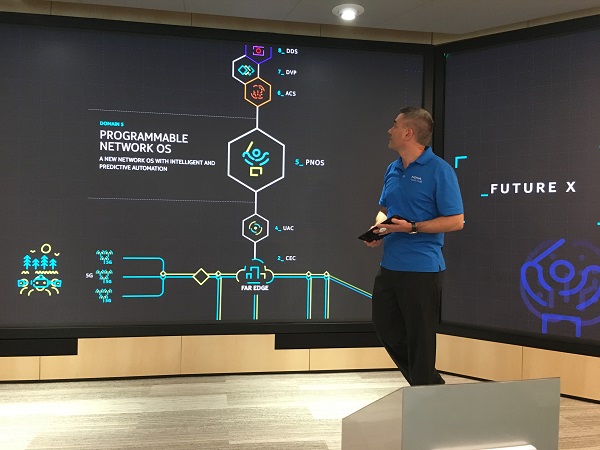
First they’ll sit down in a futuristic network control center and see what tweaks can be made to change their productivity outcomes. Then, they’ll virtually tour a simulated factory floor that harnesses industrial-IoT, distributed-cloud, augmented-intelligence (AI), augmented-reality, virtual-reality and high-performance networking, including advanced LTE and 5G.
Nokia Entering New Markets
Nokia is entering new markets with these AI-infused industrial networks, we learned at the press briefing. The briefing included presentations by Marcus Weldon, president of Bell Labs and CTO of Nokia; interviews with representatives of Nokia’s marketing and sales teams; and a tour of the Bell Labs Future X for industries network facility, where the company demonstrated its capabilities.
According to Weldon, networks need to become more dynamic, more scalable and more economical. They also need to create more value, and the driver for all these changes will be industry: infrastructure developers, manufacturers and enterprises.
“We’ve looked at what will serve industrial needs in detail,” he said.
One of the main components of this IoT network will be network slicing. “I’m not talking about any ordinary QoS [Quality of Service], I’m talking about QoS like you wouldn’t believe,” said Weldon.
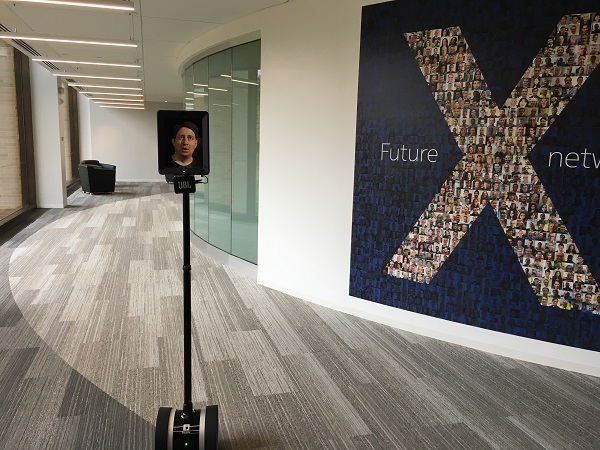
AI and IoT for a New Industrial Age
As we enter into this new Industrial Age, all applications and services in every industry will need QoS, he noted. Applications and services will have to be dynamically adapted and managed because things keep moving, so QoS will continue to be necessary. Networks will have to adapt to a changing environment if, for example, a robot is switched out or a new sensor added. Business systems also have different monthly habits, as well as different habits for various times of the day, and these will have to be accommodated. This adaptation is already becoming more tangible, real and important, Weldon said.
The market for industrial IoT is “hyperbolically large,” Weldon said, possibly $11 trillion of new value creation over the next 10 years. “If you can solve an $11 trillion problem, and 10 percent of that can come to those who solve the problem, you can imagine that this could be something that’s as large as the current industry we are in.”
“Industry is stuck at current levels of productivity. It will need a network to fix this.”
With a constantly changing network as the backbone of a new industrial application, operations technology and information and communications technology can come together. “The network infrastructure is probably the toughest part of the problem because it is a physical thing that you have to put in, dig, put things up on poles.” Until now, there hasn’t been any reason to make this happen, he said.
But now there is a reason. “Industry is stuck at current levels of productivity. It will need a network to fix this.” Weldon added that customers had come to Nokia asking if the company could fix their production environment, as Wi-Fi wasn’t working.
“No matter how many versions of optimized Wi-Fi they had deployed, it wasn’t reliable enough, didn’t have low enough latency, didn’t have enough capacity,” he said. And he noted that the enterprise business is a natural for Nokia because its sales team can operate through service provider partners or on its own, and the company has teams in many different countries worldwide.
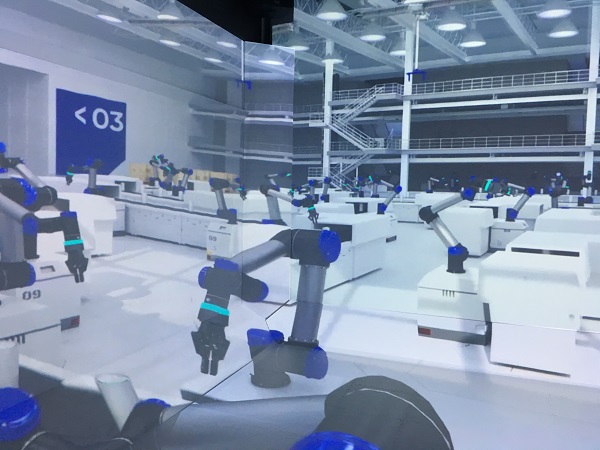
Visitors to the lab will be able to configure their networks live and to experience an emulator that recreates factory-use cases in an Imax-like theater environment. Nokia has also built a small factory that does assembly tasks, and has constructed a small city that allows it to demonstrate the flying- or moving-vehicle features of the future IoT. The demonstrations test the end-to-end performance of a network and how the network can be dynamically adapted to a representative task. Once particular network configurations are pinned down, Nokia will be able to port them to a customer’s location more easily.
Some of what is being demonstrated in Murray Hill came from technologies developed by San Mateo-based SpaceTime Insight, which Nokia acquired in May, but these technologies have been combined with technologies developed at Bell Labs. At the time of that acquisition, Nokia said SpaceTime Insight’s advanced IoT and machine learning-powered analytics technologies would accelerate the development of Nokia’s IoT offerings.
>
Esther Surden is Publisher and Editor of NJTechWeekly, and a contributor to Philly Tech News. This article originally appeared in NJTechWeekly , and is republished here with her permission.
Subscribe to:
Posts (Atom)


