Showing posts with label Princeton Tech Meetup. Show all posts

Princeton University Collaborating with Princeton Tech Meetup to Expand Local Entrepreneurship Ecosystem


Esther Surden
Publisher & Editor, NJTechWeekly.com
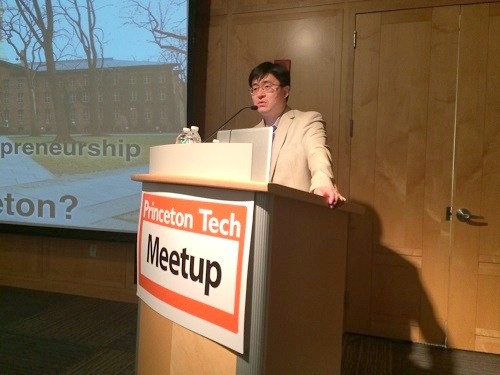

      Keller Center head Mung Chiang spoke to the Princeton Tech Meetup in May. |
      Esther Surden


Princeton University is launching a campuswide effort in 2014 to promote entrepreneurship at the school.

The New Jersey Ivy League school’s agenda includes becoming better integrated with the area’s tech entrepreneurship ecosystem and collaborating with Princeton Tech Meetup.

“The news is that the [Princeton] tiger is waking up and is going to put the university on the map of entrepreneurship and … entrepreneurship on the map of the university,” Princeton Professor Mung Chiang, who heads the university’s Keller Center, told the Princeton Tech Meetup audience at its May 21, 2014, event.

Venu Moola, Princeton Tech Meetup organizer, said the group was pleased to “announce a broader partnership” with Princeton University and the Keller Center, “to help strengthen the local tech and social entrepreneur community, accelerate the interchange of entrepreneurship ideas and talents between students and business leaders and help expand entrepreneurship activities throughout the Princeton area.”

The new initiative represents a departure for the university. “Usually the words ‘Princeton University’ and ‘entrepreneurship’ don’t show up in the same sentence,” Chiang noted at the event.

“That is a pity,” he continued. “We are here to change that together with you. There is no entrepreneurial ecosystem that can thrive without an anchor university … and … no entrepreneurial university … can survive without the local tech ecosystem.”

Princeton, of course, will be “doing entrepreneurship” its own way, said Chiang. “We will define entrepreneurship not just as commercialization and startups,” he said. For Princeton, entrepreneurship is trying to “initiate a transformative change and challenge convention through risk taking, using a small amount of resources.”

Similarly, the school has its own definition of an entrepreneur. “We define an entrepreneur as not a title but a mindset,” said Chiang. Entrepreneurs exhibit a willingness to take risks, bootstrap resources, pivot and “embrace uncertainty for breakfast” to transform a business or a part of society, he said.

Princeton sees entrepreneurs as social, cultural and technical and as movers and shakers in their own companies or within nongovernmental organizations (NGOs), the government or large companies.

Chiang told the group that a Princeton committee is working on how to change the 280-year-old school’s culture. The committee will be making recommendations by the end of 2014 and is now in the “listening phase.” Princeton is soliciting comments from the community at this website.

Noting that entrepreneurship already exists at the university, Chiang said he envisions more events that can be attended by both faculty and students and the larger tech and entrepreneurial community.

He is especially keen on gatherings focused on industry verticals like telecom, his field, and pharma or healthcare. Said Chiang, “We will meet regularly and frequently” and, “We will get specialists to meet with generalists.”

The Keller Center offers entrepreneurship courses, provides internship matching for students and holds conferences and workshops. This summer, seven teams will be attending the Keller Center’s eLab Summer Accelerator Program at Princeton University for the university’s students. There is an entrepreneurship club (e-club), which hosts an annual hackathon as well as the TigerLaunch competition. And the Princeton Entrepreneurs’ Network holds an annual business plan competition.

Changing topics, Chiang was frank about the differences between the New Jersey tech ecosystem and the one in California.

He said that in Silicon Valley, where he had received degrees from Stanford, the ecosystem is so strong that people know the home addresses and cellphone numbers of the VCs, lawyers and accountants who serve the startup industry. They are accustomed to driving over to their homes and knocking on their doors, he said. They can also easily find prospective chief marketing officers, CEOs and CTOs for their companies.

Said Chiang, “You can drive up to the homes … and knock at the door and say, ‘I’ve got a great idea — give me three minutes and tell me what’s wrong with it. Tell me who I should call. Tell me how I can fail fast. Give me the phone number of a potential customer that will tear apart my business plan.’ You can actually go there and knock on the door.”

After Chiang gave his remarks, the Princeton Tech Meetup audience had a lively discussion. One participant pointed out that the university has a long way to go to overcome its reputation for being “insular.”

Chiang said Princeton would be reaching out the community to get the word out. The goal, he said, is to change that perception regarding entrepreneurship. He noted, “I think as far as entrepreneurship is concerned, we all have to help each other. A rising tide will raise all boats.”

Asked whether an open ecosystem would overwhelm Princeton, Chiang said that as far as meetings go, “I don’t think there should be a gating function.” If Princeton starts an incubator or begins a VC fund, which it hasn’t yet decided to do, there would be criteria for access to them because a screening process would be needed to ensure that resources are allocated properly,  he noted.

Other audience suggestions made at the meetup: facilitating Princeton student internships in the local tech community;  streamlining the transfer of technology invented at the university into the greater community.


Esther Surden is Publisher and Editor of NJTechWeekly, and a contributor to Philly Tech News. This article originally appeared in NJTechWeekly, and is republished here with her permission.


Princeton Tech Meetup Holds Demo Evening Featuring NJ Startups


Esther Surden
Publisher & Editor, NJTechWeekly.com

At the August 20, 2012, Princeton Tech Meetup, three N.J. startups took to the floor to demo their products to a highly enthusiastic group of 155 developers, entrepreneurs, consultants and others. Pre-meeting networking at this event was in high gear as attendees connected with like-minded colleagues over pizza provided by Casabona Ventures.

The meetup, which launched just seven months ago, has reached 712 members and is growing quickly. “We are officially the second largest tech meetup in N.J.,” co-organizer Venu Moola told the group, which meets monthly at the Princeton Public Library community room.

First up at the podium was HootBoard (Robbinsville). According to founder Satyajeet Shahade, HootBoard is “an interactive online bulletin board that lets users communicate with their communities.” It’s not a social network; it’s a community, he added. HootBoard is in private beta, and Shahade said he was seeking the Princeton Tech Meetup crowd’s feedback.

The idea: no more walking across campus or to a town center or grocery store to post fliers, hoping others see them. Users can post items to buy or sell, jobs, event announcements, activity partner requests and so on, on a virtual bulletin board limited to a defined community.

Shahade took some time to explain the difference between a social network and a community and the value proposition for developing a community space. Social networks start at the core with pre-established relationships, beginning with two people and branching out based on whom you know and who knows your friends. Essentially, everyone has only one social network, even though each person may interact with different portions of it on different platforms.

A community, on the other hand, is a group of people who come together based on common interests. Said Shahade, “That’s very different from a social network. People within the community may have some interpersonal relationships, but that’s not the bond that forms [within] the community.” Communities can be nested, and there can be multiple communities within a community, or overlapping communities. One person can be a member of more than one community, he added.

Next up was Payintele (Robbinsville), a payment platform for mobile that is still in beta. Avinash Kuttuva, founder, gave a demo of the product, which is available for Windows, Mac and Android, with the iOS version coming soon.

Payintele is applicable to a host of situations; it’s not just for paying back buddies but also for use at Starbucks and by merchants, Kuttuva said. “We are introducing something called ‘share,’ ” he noted, comparing the product to an add-on credit card for a child or spouse. “Share does the same thing: it controls access to your funds and shares that with people you trust,” he added. The difference between it and an add-on credit card is “you have control at the touch of a finger, any time you are awake and have your phone with you.” You can monitor where other people are spending money, and deactivate sharing any time you want.

Payintele will also let businesses accept payments via a tablet or an iPhone. They can set up payments in a few minutes, and terminals can be located in multiple places so more than one person can collect payments simultaneously with no special hardware needed.

For security, the app will collect the user’s photo, which will be sent to merchants so they feel confident about accepting payment.

Presenting next were RJay Haluko, creative director, and Patrick Pierson, mobile app developer, at Princeton Junction-based Local Wisdom, producers of Wooble Attack, which we covered when it launched. The developers showed a demo of the app, which is a bit like Whac-A-Mole, using the phone’s swipe feature.

Wooble Attack players receive points and tokens, and tokens are used to obtain bonuses. Standard mode is timed, but those playing for skill can use accomplishments to add time to their totals. Players can earn extra powers, and there are impediments introduced to keep the game interesting. For example, if a bomb is touched, that spoils the score. Users can make in-app purchases to increase their powers as the game becomes harder.

The developers enthusiastically discussed using Unity 3D, a tool that lets programmers develop across platforms. “This allowed us to work in one code base and export to iOS, Android, Mac, PC and Xbox,” Pierson said.


Esther Surden is Publisher and Editor of NJTechWeekly, and a contributor to Philly Tech News. This article originally appeared in NJTechWeekly.


permalink


A few interesting area events this week not on Philly Tech Week's Calendar


Princeton Tech Meetup Tonight (April 23) at 7pm at the Princeton Public Library. Four spots open right now, according to its Meetup page.

Philly FileMaker User Group Tuesday, April 24th, at 6:00 PM. at IT Solutions in Fort Washington. Presentation on the new FileMaker 12.

Cloudforce Social Enterprise Tour Wednesday, April 25, Washington DC. Features keynote from Vivek Kundra, EVP of Emerging Markets at salesforce.com and former CIO of the United States.

State of .NET - The Road to Windows 8 Microsoft Malvern on Thursday, April 26 from 2:00-5:00.

System Center User Group Microsoft Malvern on April 26 from 5:30 to 8:00 pm. Best of Microsoft Management Summit 2012 review and see live demos of next generation Windows Server "8", Hyper-V 3.0, and Windows 8.

PhillyForce April Meeting April 26, 6 to 8 pm, at LiquidHub in Wayne. How MEI (West Chester), maker of electronic bill and coin acceptors, uses the Boomi Platform to Integrate Salesforce and SAP ERP.

Delaware Tech Meetup Thursday, April 26 at 7:00pm at
the The coIN Loft in Wilmington. Focus on EdTech.


permalink


Inaugural Princeton Tech Meetup Draws Enthusiastic Crowd


Esther Surden
Publisher & Editor, NJTechWeekly.com


An enthusiastic bunch of tech professionals attended the Princeton Tech Meetup kickoff meeting, held in the basement of a Nassau Street bar, on March 19. It was a promising beginning for a group pulling together tech developers and entrepreneurs from the central Jersey area.

The first meeting was primarily a networking event, drawing 90 attendees and providing them plenty of low-cost drinks.

The organizers, Chris Boraski, a Montgomery County web developer, and Venu Moola, a marketing and advertising entrepreneur and technology executive who lives in the Princeton area, promised to try to get faculty and students from Princeton and other nearby institutions involved in their effort.


Their goal: to bring together tech types, creative folks, entrepreneurs and investors. Some we spoke to in the audience were on the business side of startups; others included marketing people looking for prospects and even an advertising rep.

David Deutsch, a Flemington-based chief strategist for SynergiSocial, provided an introduction to social media that was well received. When businesses use social media--Facebook, Twitter, LinkedIn, and the like--to promote their products or services, they generally don't get anywhere because social media is, at its core, not marketing, Deutsch said.

Businesses need to understand that “it is a conversation, a place to connect, collaborate, ask questions, answer questions and get to know people. Indeed, it is the world's largest global conversation taking place right now about every topic imaginable, and it is happening with or without you.”

Travis Kahn, the newly appointed executive director at TechLaunch, the NJ tech accelerator that will be based at Montclair State University, explained how accelerators work to nurture, as well as speed to market, seed-stage companies. He asked audience members who thought their companies might be a match for TechLaunch to contact him.

Jeff Blake, N.J.-based vice president of sales for E-Zassi (Fernandina Beach, Fla.), an integrated online business-network, decision-support software and technology marketplace, spoke about open innovation in the life-sciences device marketplace. “We provide analytics and security for medical-device and life-sciences customers by automating the idea-capture process,” he said.

If there was one complaint, it concerned the noise level. Speakers had to compete with the venue’s sound system, and many in the back of the room gave up on listening because it was too difficult. The organizers are working to remedy this. A lot of business introductions took place at the kickoff, so most attendees were satisfied with the outcome and are looking forward to the next meetup.


Esther Surden is Publisher and Editor of   New Jersey Tech Weekly , and a contributor to Philly Tech News. This article originally appeared in New Jersey Tech Weekly.

(Editor's Note: The next Princeton Tech Meetup is scheduled for April 16; location hasn't been determined yet.)


permalink