Links 4/4: Comcast-funded Atairos invests $250 million in Groupon


 Subscribe in a reader
Subscribe to Philadelphia Tech News by Email


Tech Leader to Establish Roots at uCity Square: Microsoft Innovation Center Comes to Philadelphia (PR Web)

Comcast-Backed Firm Makes $250 Million Investment in Groupon (Bloomberg)
Back to the future?
Actually, the supposed promise of Groupon was for it to replace the Yellow Pages.
Trying to find out if this is Atairos', the mosly Comcast-funded investment group headed by former CFO Michael Angelakis, first investment.
Interesting quote by Aaron Turner, an analyst with investment firm Wedbush Securities. in Internet Retailer: “The new one today, I think it’s a little unclear as to the benefit that Atairos gets from this. I don’t think it’s a good strategic fit for Comcast. I highly doubt that they’ll be able to forge any meaningful partnerships from this deal.”
Of course, that's only one analyst's opinion.

NBCU And Vox Join Forces To Sell Digital Advertising (Ad Age)

Why More Cloud Companies Specialize In a Single Industry (Fortune)
Yet another article introducing us to Veeva Systems.


BioTelemetry competes $6M deal (Philadelphia Business Journal)

Venmo’s secret sauce: PayPal CEO on why millenials love the fast-growing payments app (Geekwire)


Sunday Highligts: YES Network, Comcast dispute rages on; SAP S/4HANA functional completeness in eye of the beholder


 Subscribe in a reader
Subscribe to Philadelphia Tech News by Email


IPO window slams shut on 22 tech companies seeking just $1.5 billion (VentureBeat)

The inside story of how Amazon created Echo, the next billion-dollar business no one saw coming (Business Insider)

SAP S/4HANA functional completeness in eye of the beholder (SearchSAP)

Workday: UBS, FBR Laud Progress in Financials Software (Barron's Tech Trader Daily)
But will Workday Financials appeal more to mid-sized firms, while Workday HR is bought by mega corporations? Possible market mismatch.


Yankees' Opening Day: YES Network, Comcast dispute rages on (NJ.com)
I would guess Comcast proporties involved in dispute are likely prospects for swaps reportedly discussed among Comcast, Cablevision, and
Charter once all the deals are done. To Comcast, these systems are probably outliers from their main market areas.


Netflix throttling itself isn’t a net neutrality problem, FCC chair says" (Ars Technica)

The insurance tech equation (TechCrunch)


Saturday Highlights: Foxconn and Sharp ink deal: Comcast Ventures in latest Slack round


 Subscribe in a reader
Subscribe to Philadelphia Tech News by Email


IBM CULLS THE PACK OF SALESFORCE PARTNERS BY BUYING BLUEWOLF (HfS Research)

Key Analytics Duo Leaves Salesforce (The Information)

More: $10M for SAP boss McDermott: proxy (Philly Deals)


It's Official: Foxconn and Sharp Inked Their Deal (Fortune)

Slack, a Leading Unicorn, Raises $200 Million in New Financing
(NY Times)
Led by Thrive Capital with participation from GGV and Comcast Ventures; Slack values at $3.6 billion,


Moneyball is dead. Long live Moneyball! (TechCrunch)


CEOs, VCs Talk About Real-World Startup Valuations at teq.Konnect February Meeting

Esther Surden
Publisher & Editor, NJTechWeekly.com


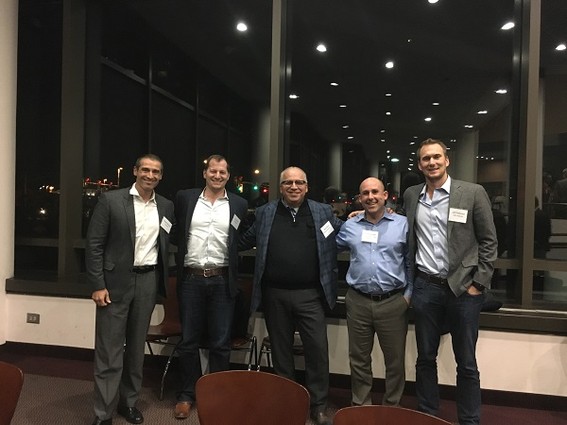
      Panelists flank moderator David Sorin at teq.Konnect in February. | Esther Surden


Between soaring valuations that have reached more than $1 billion for tech or tech-enabled “unicorns” and the recent volatility in the stock market, it’s a no-brainer that entrepreneurs may be confused about the issue of company valuation.

In February, a panel of venture capitalists and venture-backed tech-company CEOs addressed the issue at a teq.Konnect meeting at the East Brunswick office of the law firm McCarter & English.

They were especially interested in how to arrive at just valuations that would correctly position companies to be attractive to investors in future funding rounds.

The panelists included Greg Besner, founder and CEO, CultureIQ (New York, NY);  Scott Feldman, managing director, Susquehanna Growth Equity (Bala Cynwyd, Pa.); David Olk, cofounder, ShopKeep (New York, NY); and Jeff Parkinson, managing partner, KEC Ventures (New York, NY).

The panel was moderated by David J. Sorin, the managing partner of McCarter’s East Brunswick office and the head of the Venture Capital & Emerging Growth Companies practice.

Are valuations too high?

After the panelists introduced themselves, Sorin addressed what he called the elephant in the room. “Everyone is talking about whether we are on the precipice of another bubble, whether valuations are too high. What do you think are the long term trends in valuation?”

KEC’s Parkinson, whose company invests at the early stage, said that he was already seeing valuations come down a little bit. “As an early-stage investor, we usually say ‘who cares what happens in the public markets?’ But at the end of the day, we are affected.” He explained that if it’s harder for companies to go public, then everyone has to be a little more careful with his money.

“There’s been nothing too drastic yet,” he added. “Our advice to our companies has been if you can raise a little bit more [capital] now, do it.” Parkinson believes that his fund will continue to invest at the same pace as before, doing 10 to 12 deals a year.

“But we’ll have to be prepared to put a little bit of extra money aside to bridge some of the companies until they can get to their next round, and see how this plays out.” They used to say that if you were a Software-as-a-Service [SaaS] business, you needed $100,000/month to go out and raise your A Round, but now it’s probably more than that, he explained.

Some growth companies can wait out a bad market

Susquehanna’s Feldman said that most of the companies his firm invests in tend to be in the growth stage. A lot of them are making money and are profitable. “Their option in a market like this is to do nothing. They sit back. They wait a year. They wait two years if they think that the market isn’t good for them to raise capital or sell a piece of their business.” But when those companies decide to wait before moving on or exiting, it can affect Susquehanna’s ability to put money into other companies. “We invest in three to four companies a year, and I think it will be hard to pull that off” if companies hang back, he said.

However, Feldman thinks that there continues to be a huge demand and movement towards automation and technology, and that there’s still a huge part of the economy that isn’t taking advantage of technology.

“Valuations will probably come down. You will see companies with big valuations and big burn rates … go away in the next six months. They will probably consolidate or go away because investors won’t be able to justify [supporting] them anymore.” He added that good companies, even ones that are losing money (but not irresponsibly), will still succeed. Some of the best investments, he reminded the group, were made during some of the worst years for the economy: 2007 to 2009.

Broader market volatility affecting consumer-facing businesses

While he is not raising capital at the moment, ShopKeep’s Olk noted that colleagues had told him that the broader market’s volatility is affecting them, depending on what pocket of the market they address. Business-to-business (B2B) companies that are generating revenue aren’t seeing a crunch in multiples, he said. However, consumer-based businesses that have to invest in customer acquisition are typically more affected by the downturn because consumers are fickle and are more expensive to acquire. “Those are the companies I worry about more in this kind of market,” he said.

Olk stated that valuations are “completely irrelevant” until he has a term sheet. When he raises capital, he said, “I work on the common denominator that nobody wants to miss out on the deal, so the deal will move as quickly as I do.”

It’s like dating, he said. “I want to be the best-looking person at the prom. I lead a process where I try to make as many friends as I can, but I can be passive-aggressive about the way I approach it, depending on how badly I’m looking for capital.”

He noted that, to be attractive, a company has to have a large addressable market, a fantastic team and a product that people like. But those factors just get you to the table. “If  I don’t have a term sheet, then I’ll be worried about the multiple that the VC is willing to play. That changes, depending on where you are in the genesis of your company.” If you are a seed- or early-stage company, it’s more about product vision; as you move on, it’s about metrics and momentum, said Olk.

Besner added, “I do think that, especially in SaaS, there is already an adjustment going on.”  He noted that many high-flying companies in his sector of human resources are contracting in valuation. “I’m feeling an immediate effect. I’m having investors contact me on the topic.”

Both Besner and Olk pointed out that there is a Series A crunch underway. The amounts deemed to be seed money are moving upward. “We are a B2B SaaS company trying to raise capital, and we worry about the Series A crunch,” Besner said. “We just raised $3 million, which was deemed seed, which would probably have been considered Series A or close to a Series A not too many investment cycles ago.”

“I do think that the best time to take capital is when people will give it to you,” he added. 


Taking smart money is best

Sorin then asked the CEOs on the panel how they handled the tension between trying to get the best valuation for their startup and having a valuation that positioned them for future growth. The founders had different opinions, based on their positions in the market.

When ShopKeep was in the process of raising a $60 million round, investors were more sophisticated about how they looked at the business financially, and they examined the underlying economics, said Olk. It was more about the numbers than anything else. That was because ShopKeep was in a growth stage. The numbers dictated the valuation.

“I’d rather not have a greedy valuation,” said Besner, whose company is earlier on. “I’d rather have the fuel to be able to reach the next milestone.”

Besner added that, in the last round of financing, his company received multiple term sheets, and, “We did reach a valuation that was fair.” CultureIQ’s business had doubled in the prior six months, he said, and that is exciting.

 “I think it’s important to have the right valuation,” not just a valuation that makes your company look as if it’s worth more than it is, Besner said. “Some of my prior investors were willing to invest in a significantly higher valuation in this last round, but we wound up taking capital from some institutional early-stage venture funds at a valuation that was more modest.”

Besner considers it important to have the right partners, “in the sense that they could help me grow the business smarter, thinking about unit economics, thinking about the strategy and the approach and making sure that we approach each stage of our business correctly.” He noted that  angel investors had “great intentions, but they just weren’t professional investors.”


Esther Surden is Publisher and Editor of NJTechWeekly, and a contributor to Philly Tech News. This article originally appeared in NJTechWeekly, and is republished here with her permission.


Links 4/1: Phorum Demo Pit finalists named; Rovi sues Comcast for patent infringement


 Subscribe in a reader
Subscribe to Philadelphia Tech News by Email


Demo Pit Finalists Announced for Phorum 2016 (PACT)

Oracle Cloud teases public cloud behind the firewall (TechTarget)

Why IBM spent $200 million to buy a huge Salesforce partner with Marc Benioff's blessing (Business Insider)

Rovi Sues Comcast for Patent Infringement, Shares Fall (WSJ: CMO Today)


Rovi Plummets Following Patent Lawsuit Against Comcast (Bloomberg BNA)

Happy Valley LaunchBox officially open for businesses (Daily Collegian)

Dell-Owned SecureWorks to IPO This Month (Re/code)

This week in N.Y.C. funding news: Raden, Major League Hacking, Slice Labs (New York Business Journal)

Asana Raises $50 Million for Its Task Management App: Why It Matters ( Chris Kanaracus, Alan Lepofsky / Constellation Research)


First Round Capital establishes Romper Room Fund


Tom Paine


 Subscribe in a reader


Because of the notable success of First Round Capital's Dorm Room Fund on college campuses, the venture capital firm today announced the formation of the Romper Room Fund.

Named after the long-running TV show, the Romper Room Fund will target three to four year old pre-schoolers. "This is simply a natural progession in our efforts to identify younger startup founders. We think we have a formula for identifying potentially successful entrepreneurs at an early age," said First Round partner Josh Kopelman. The firm has developed a complex algorithm, similar to those at some of its portfolio firms, that predicts a child's probability for entrepreneurial success.

Kopelman emphasized that the pre-schoolers will not be burdened with major responsibilities at such early ages. "We will give them perhaps a few thousand dollars seed money to play with to see how they do."

An appropriately scaled incubator will be established, with a plentiful supply of cookies and juice and plenty of nap time.


Links 3/31: Kevin Hart partners With Lionsgate on Streaming Service; DraftKings and FanDuel suspend all college sports contests


 Subscribe in a reader
Subscribe to Philadelphia Tech News by Email


Kevin Hart Partners With Lionsgate on Laugh Out Loud Streaming Service (Variety)

DraftKings and FanDuel suspend all college sports contests in deal with NCAA (The Verge)


IBM to buy Salesforce.com consulting specialist Bluewolf (PCWorld)

PaaS providers – where the cloud wars are really being fought (CBR Online)
Interesting and somewhat different perspective.

Tableau plus HyPer: “Something up their sleeve” (Datadoodle)

Amazon in talks to buy stake in mapping company HERE: sources (Reuters)


'Fair' or poor'? Funds slam Checkpoint sale, $4m CEO payout (Philly Deals)


Philly Tech Peoplenews 3/31/2016: RIP Brenda Gavin; Unisys adds key hires


Subscribe to Philly Tech People News by Email


Brenda Gavin, 67, leader in health-science investing (Philadelphia Inquirer)

Comcast Promotes SVPs (Multichannel News)

Comcast Promotes Eight Execs To VP (Multichannei News)

Comcast's Cohen Named Digital Commerce Advisor (Broadcasting & Cable)


Unisys Names Inder M. Singh as Chief Marketing and Strategy Officer (PR Newswire)

Unisys Names Andy Stafford as Senior Vice President of Services (PR Newswire)

Qlik CIO: Resist the 'bandwagon' effect when dealing with rapid tech changes (CIO Dive)


Giant hires new Philadelphia GM and creative director (Medical Marketing & Media)

New Jersey CIO Steve Emanuel Heads to Private Sector (GovTech)


AmeriQuest Business Services Names Glenn Boyet as Director of Corporate Communications (Business Wire)


Zonoff prepares for Connected Home IoT Platform Battles


Tom Paine


 Subscribe in a reader


The early days of the connected home Internet of Things (IoT) market have been driven primarily by the success of a limited number of one-off applications for such needs as climate control, home security, and lighting.

But as more apps and smart devices come to market, and with them the need for greater integration, the importance of broader, multifunctional and open (agnostic) platforms is growing.


Zonoff Platform / Zonoff Website


And Malvern's Zonoff is positioned to be a leading factor as a white label solution that works as a behind the scenes hosted solution for major partners.

But can a relatively small, independent player survive alone in a land of giants? All the major tech giants are building their own strategies, although some are further along than others.

And the pressure to establish greater standardization in what is sometimes a Tower of Babel of competing standards is growing. And consolidation will come eventually.

Mike Harris, Zonoff CEO /
LinkedIn
Zonoff was founded in 2011 by Mike Harris, a true serial entrepreneur, with prior founder stints including AnySource Media (acquired by DivX) and Ravisent Technologies (acquired by STMicroelectronics). Zonoff's initial platform was built "after acquiring a field-proven technology portfolio that had been under commercial development since 2004," according to Zonoff's website, referring to East Falls-based wireless tech firm BuLogics, although Zonoff says that BuLogics technology now accounts for only a tiny percentage of its code and functionality.  Zonoff's current CTO and co-founder, Michael Balog, Ph.D, joined Zonoff from BuLogics.

Zonoff has raised $35.6 million, including $31.8 milion in late 2014. The latter round was presumed to include a major strategic investor, the type of large partner it needed, which was probably ADT, the home security giant, according to reports. There's been no confirmation from either Zonoff or ADT on this.

Zonoff's most widely acknowledged customer has been Staples, the world’s largest office products company and fourth largest internet retailer according to Internet Retailer.  Staples has marketed its solution under the name Staples Connect.


Staples Connect, particularly with the new D-Link hub, has been well reviewed and received in the market, though its not clear what the sales results have been. But Staples has definitely been perceived as an early IoT leader due to Staples Connect.

A recent organizational shakeup at Staples, and the (maybe temporary, this time?) failure of the Office Depot merger to be approved is not expected to have a negative impact upon the Staples-Zonoff relationship, I was told in a briefing with Zonoff, despite some reports in the tech media that it might be "windng down".

Zonoff has other customers, but is very quiet about them.

So is ADT now a Zonoff customer? Well, no confirmation on this either, but here the story gets complex.

Various sources ( CE PRO is the most cited original source) have reported that ADT has split from iControl, the company whose DIY home security automation app ADT had been using. (iControl has also been part of Comcast's home automation solution, and Comcast is an investor in iControl, as is ADT.)  ADT is reportedly going with a base solution developed by LG, with proprietary enhancements by Zonoff,  hosted on Zonff's SaaS IoT platform.

iControl has a patent-infringement lawsuit against Zonoff dating back to 2014, and tacked on additional complaints to it late last year.

Also, I sense that Zonoff may be trying to make inroads at Comcast.

Zonoff has more than 100 employees now, situated in the new Malvern headquarters it opened last year.


At CES in Las Vegas in January, Zonoff made several important announcements aimed at broadening its capabilities. Perhaps the most important of these were Zonoff's upgraded Z1 Software Suite and its partnership and app integration with HomeAdvisor.

You can see Zonoff's partner ecosystem here.


Links 3/30: Comcast to deliver StreamTV to rivals' customers within its footprint; Fidelity starts testing Robo-Adviser Service on existing clients


 Subscribe in a reader
Subscribe to Philadelphia Tech News by Email


Here's How GlaxoSmithKline's CEO Thinks Pharma Should Modernize
(Fortune)

Fidelity Starts Testing Robo-Adviser Service on Existing Clients (Bloomberg)


Comcast to Deliver Stream TV to Rivals' Customers (TVPredictions)

Cablevision, FourthWall Go National With Analytics (Multichannel News)

Comcast, EA to End X1 Gaming Trial
(Multichannel News)

IBM to Acquire Cloud Consulting Firm Bluewolf for About $200 Million (Re/code)
Bluewolf has very active Philadelphia office, and is particularly important to the area's Salesforce ecosystem.


Fidelity marks down stake in pre-IPO startups Cloudera, Dropbox (Reuters)

SAP Ariba growth may come through SAP Business Network (SearchSAP)


10 Questions for Badri Nittoor CEO of Cherry Hill B2B Startup eureQa

Marc Weinstein
NJTechWeekly.com


Badri Nittoor, cofounder and CEO eureQa | Marc Weinstein


Cherry Hill-based eureQa, a test automation Software-as-a-Service (SaaS) startup, offers a solution to the inefficient, time-consuming and the often expensive task of testing software.

The company’s flagship product, the eureQa Testing Platform, helps build tests without programming and runs these tests on hundreds of combinations of Web-based browsers, operating systems and devices on the cloud.

Since 2014, the young company, a subsidiary of Tripod Technologies (Cherry Hill), has been selling its automated software-testing product to various firms involved in e-commerce, as well as to independent software vendors (ISVs).


With the explosive growth of the $1.6 trillion global e-commerce business, it’s critical that software testing be accurately and consistently done across all browsers and devices, to ensure a positive user experience on e-commerce sites. Otherwise, the odds are high that the sites will not work properly, resulting in frustrated and angry customers and lost revenue for companies.

Automated software testing is considered to be more efficient, less costly and substantially more accurate than manual software testing. Moreover, until recently many of the software-testing tools on the market required programming skills. This meant that companies had to pay high licensing fees for the testing software; and to build and run the tests, they had to hire programmers, many of whom didn’t understand how the applications or sites worked.

That isn’t the case with the eureQa Testing Platform. Those who have a thorough understanding of e-commerce sites don’t need programmers to use it.

The platform provides similar benefits to the ISV market. Because ISVs are making changes to software on a daily basis, the software has to be tested daily as well. And with the large volumes of software testing being done in a very short span of time, ISVs are ideal candidates for automated testing.

Demand for software-testing tools like the eureQa platform has grown significantly in recent years, as the adoption of test automation in the $37 billion worldwide software-testing market has increased.

Basic info:

Company name: eureQa.

When did you launch the company? 2012.

Product name: eureQa Testing Platform.

Cofounder and CEO: Badri Nittoor.

New Jersey location: Cherry Hill.

Team: Bhargava “Bari” Chittamuri, cofounder, chief operating officer and CTO

Any employees yet? The company has 68 employees, with 60 at the company’s facility in Hyderabad, India.

Funding: The company secured $600,000 in seed funding from Philadelphia-based Gabriel Investments in December 2015. Sashi Reddi, an investment partner at Gabriel and founder of AppLabs (Philadelphia, Pa.), joined eureQa’s board.

Markets you are serving: E-commerce and ISVs.

Entrepreneurial Questions:

1. What is your New Jersey connection? What brought you to New Jersey, and do you plan to stay here?

In the mid-1990s, I was working at a Baltimore software company when I accepted a job offer at Bluestone Software, a successful South Jersey company. That’s where I met Bari. After we left Bluestone, we started Tripod, an outsourced software-development-product company, in 2002. I live in Voorhees and Bari lives in New Brunswick. For the foreseeable future, we both plan to continue living in New Jersey.

2. What problem are you solving?

Following the global financial crisis in 2008, most startups funded by venture capital firms were told that their software development had to be done in the most efficient way. They were told to look for an offshore provider or a low-cost center to do the testing. But the problem is that today there are no more “new” low-cost centers around the world. So the only way to reduce your costs is through automation. U.S. companies that are using automation for software testing are going to be able to compete better than companies in traditionally low-cost centers like India, Vietnam and other places where a lot of manual testing is being done. These centers have relied on large pools of inexpensive manpower to do the testing — manpower that is not so low-cost anymore. We are providing a path to increased productivity by enabling automation to reduce costs. In addition, we are providing a way for manual testers to migrate to automation, giving them the skills they’ll need to test software in the most cost-efficient way possible.

3. Why can you address the problem better than anyone else?

Our approach focuses on having the people who best understand the software being tested to build the automation. These are the subject-matter experts, business analysts and others who understand how a user will handle the software and how to best simulate the user experience. They can also ensure that the most accurate and realistic tests are conducted.

Furthermore, these tests are easily run at a click of the button on the cloud, thus reducing a company’s capital expenditure and making the move to automation a great experience. Our testing software has the quickest payback, and we have seen much evidence of this, compared with other tools and approaches.

4. How did you come up with the name of the startup?

We were looking at all sorts of variations of a name in order to show that we were coming up with a novel approach to solving a problem. We tried various combinations of names, using such words as “test” and “quality,” but did not like any of them. Then one day, while I was driving on the New Jersey Turnpike, I had my eureka moment and realized that that would be a great name for the company. We then decided to change the letter “k” to a “q” so that the name ended in “Qa," which would stand for quality assurance.

5. What was the biggest mistake you made in your entrepreneurial journey and what did you learn from it?

I’m sure that I’ve made many mistakes, like every entrepreneur. But I think one of the things that really stuck with me was putting people in positions that were not the right fit for them, and then leaving them there longer than I should have. Sometimes the problem is solved when it’s just a question changing their role a little bit or putting them in an area where they are most comfortable. But there are times when it becomes very clear that they are not a good fit for the position. In some cases, like with developers, it is easier to determine fit because you quickly realize if they can or cannot do the work. In other areas, it’s a little more difficult because there are other factors at play. So you have to separate those external factors from the individual’s abilities when deciding if he or she fits a particular role. Right now, we are spending more time assessing a person’s fit for a position before committing to putting them in that particular role. This allows us to have more of an extended evaluation, so we can see whether they are a good fit.

6. When was the last time you thought about quitting your startup and going back to corporate life, or doing something else? What got you to stay?

We’ve been at this for so long, I don’t think going back to something else is what we want to do. But we did have some serious questions about the business after the global financial meltdown in 2008, when we lost a few large customers.

At that time, there was the question of what we should do. Both my partner and I sat down and talked seriously about the business. We decided that we had put so much time into the business that we should give it more time. We knew it was going to be a difficult six months to a year, but we spent the time, went through it and survived.

7. If you could go back in time, what would you do differently?

One thing would be to avoid relying so much on a couple of large customers. When the going was good with a few customers, you tend to go with it. But we should have diversified more in order to limit our exposure. After 2008, we had a couple of large customers who closed down, and that significantly impacted our business.

When things picked up, we had a few large customers again, and then we realized that this was the nature of our business. That’s why we moved to building a product to a point where we now have a lot more customers, all pretty much evenly spread, so you don’t have things tied to one or two customers. It’s not an 80/20 situation, where you have 80 percent of your business coming from 20 percent of your customers.

8. What’s the best place to find founders to network with?

I belong to a couple of organizations. One is called “The Indus Entrepreneur” (TIE), an organization with over 60 chapters worldwide. It’s a great place for meeting entrepreneurs. There are local networks as well. I am part of a group called “Technology Leaders of the Delaware Valley,” which is a great group of entrepreneurs and technology company founders. Organizations like the New Jersey Technology Council and the Philadelphia Alliance for Capital and Technologies (PACT) are also great places to network with peers.

9. What does your family think of you being an entrepreneur?

They are very supportive. My wife is extremely supportive. I wouldn’t be able to do this without her being part of it. As for my kids, who are 12 and 14 years old, my being an entrepreneur is the only thing that they have known from the time they were born.

10. What has helped you the most to achieve your current success?

I think it’s significant to have the right team of people, support from a great partner, and mentors and advisors whom I can call on to ask questions or to bounce ideas off of them.


Marc Weinstein is contributor to NJTechWeekly. This article originally appeared in NJTechWeekly, and is republished here with its permission.